Noted
NotedClarity.
Built for learning.
Luminous turns deep, complex topics into clear, beautifully paced lessons. Expect slideshow-style courses, and interactive tools you can actually steer — designed for understanding, not memorization.
- 20courses
- 2,085lessons
- 26,110slides
Twenty courses, six subjects
Every course is built the same way, whichever shelf you pull it from.
How a lesson runs
Five beats, the same order every time, in all 2,085 lessons.
Hook
A slider, a scene, a thing to drag. You are moving something within five seconds of opening the lesson.
Observe
You predict what happens next, commit to an answer, and only then see the result. The reveal does the teaching.
Name
The word arrives last. One term, for the pattern you already watched happen two slides ago.
Formalize
Now the equation, read as shorthand for something familiar rather than a rule to memorize.
Use it
You apply the new tool to a problem that needs it. If it works here, you own it.
On a laptop or a phone.
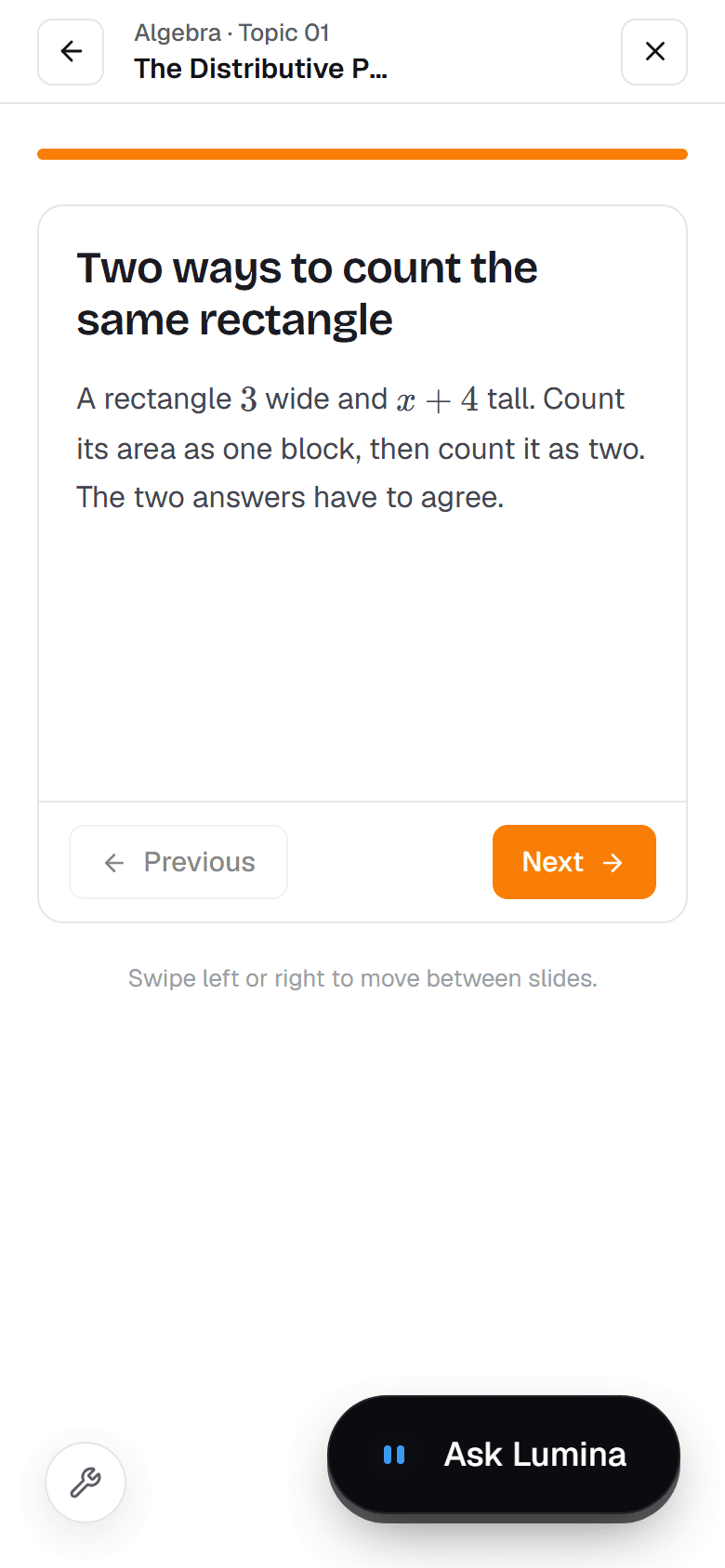
The same lesson and the same interactives, on either screen.
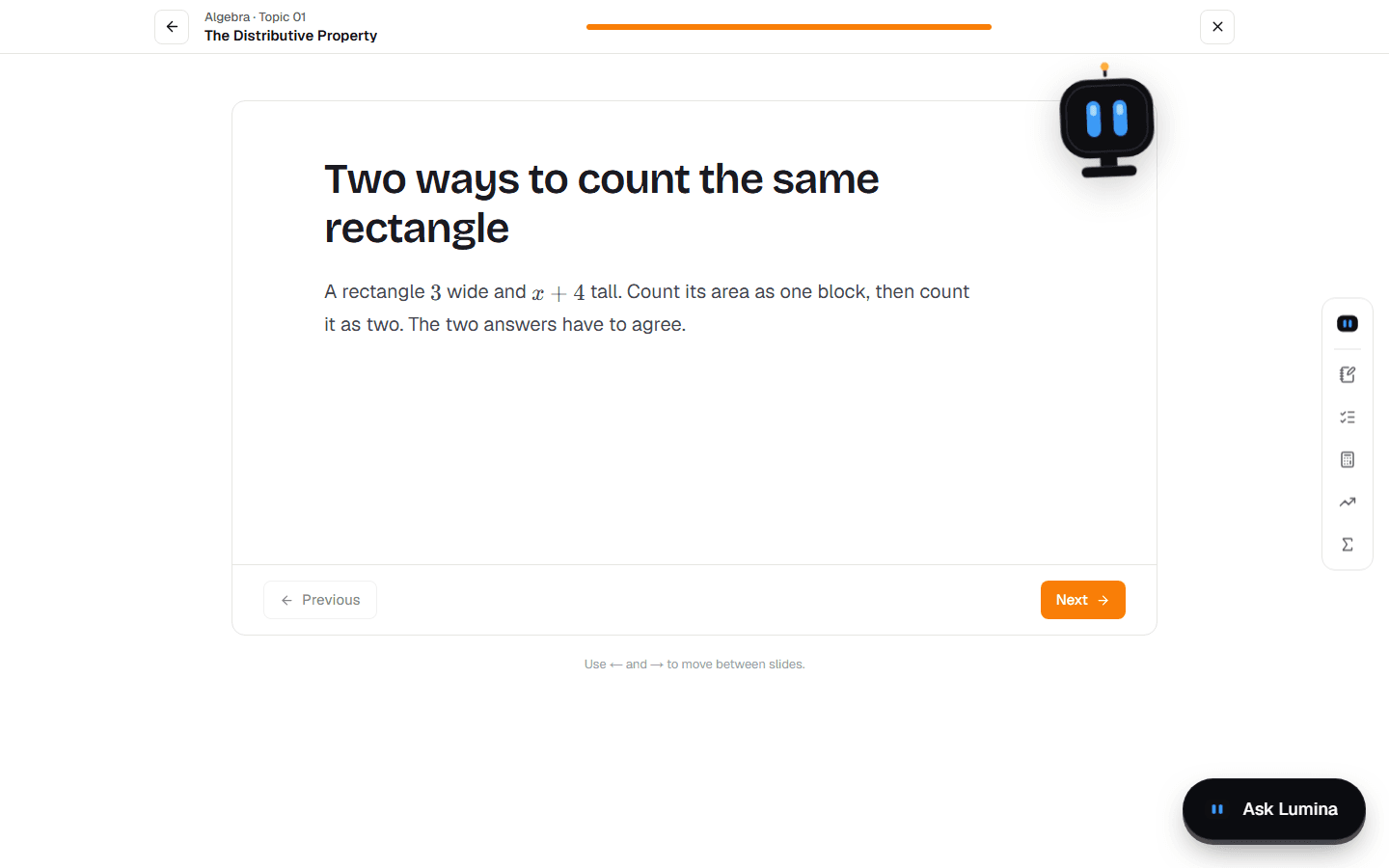
Slides you can steer
Read a page, drag a marker, answer a question, watch a plot redraw. A lesson moves between these every few slides.
Two handles are dragged to place the line x + y = 4, the region below it is clicked, and the shading turns green as Lumina looks on.
Concepts that click.
Every lesson is a sequence of slides with something to move. Drag a probe along a number line, drop atoms onto a Lewis diagram, rotate a function plot. Each slide kind teaches a different idea by giving you something to move.
Built to be finished
The parts that keep a course from stalling out three lessons in.
A cursor drags the slope handle on a line graph and the coefficient in the equation rises with it.
You do it before it gets a name.
Drag the handle and watch the line answer. The coefficient in the equation is the label for the thing you just felt, handed over once you already know what it does.
A cursor picks an answer on a prediction slide, presses Reveal, and the explanation panel opens.
Predict, then see.
You commit to an answer before the explanation exists on screen. Being wrong for a second is what makes the reveal land, so every lesson asks first and tells second.
A bracket lights the pair being multiplied, a cursor drags the 2x token from the bank into the empty slot, and Lumina squints as the check lands.
Lumina answers with a slide.
Stuck mid-expansion? Ask in plain words and the reply is built from the lesson you are standing in, with the same pieces you were already dragging.
A cursor drags a marker along a number line from 12 to 18 and a tag confirms it is a multiple of 6.
Pick up where you left off.
Your home page remembers the slide you stopped on. Miss a step and the deck recalibrates, slotting in the one thing you needed before moving on.
Three days of streak rise as coins, the third tallest, and Lumina lands on today's.
The streak is fuel.
Finish one lesson a day and the streak grows. The gauge fills toward the next milestone, so you can see what one more day adds before you start it.
It changes with every answer
Get one wrong and the next slide is about that. Lumina is there for the miss, the fix, and the step that follows.
One multiplication problem fans out into five of increasing size, and the middle one lights: the next question is drawn from your rung.
Same idea, five sizes.
One multiplication, then the same picture at five sizes. The next question is drawn from the rung you are on, so it is never a repeat and never a leap.
A cursor drags the turning point of a curve upward, the whole curve follows, and Lumina asks whether it got any wider.
Move it, then ask.
Drag the curve and Lumina asks about what you just did, not about a rule you have not met yet.
A cursor picks the wrong option, which shakes and turns rose. Lumina asks a question back, and the second pick is right.
Wrong is a turn, not a stop.
Miss one and Lumina answers with the question that gets you there. The second try is yours.
After a missed check, pressing Next slides a fresh slope slide into the deck before the graph, and Lumina says why.
The deck reshapes.
A missed check slots one more slide on that idea in before the next one, and says so.
One note, every source.
Light and Colour · Lecture 7
3 sources · 2 chapters
Summary
Sunlight is every colour mixed together. Air scatters the blue part far more than the red, so blue reaches your eye from every direction and the sky looks blue. At sunset the light crosses much more air, the blue is scattered away before it arrives, and what is left is red.
Blue scatters, red gets through
01 · 12:04
Air scatters blue light far more than red . That is why blue comes at you from every direction, even when the sun is behind you.
- Shorter wavelengths scatter more; blue is the shortest we see well
- Violet scatters even more, but our eyes are less sensitive to it
- Clouds look white because their droplets scatter every colour equally
Why sunsets are red
02 · 14:32
At sunset the light crosses far more air, so the blue is scattered away long before it reaches you . The slide shows the longer path through the atmosphere , and the reading gives the same idea its proper name .
Free, unlimited transcription
Recording and transcription both run on your laptop. No caps, no per-minute meter, nothing recorded ever leaves the device.
Chaptered, with real citations
Every claim in a note links back to the moment it came from — 14:32 in the recording, Slide 12, or p. 87 in the reading.
One deck for everything
Flashcards and quizzes generated from your notes land in the same review deck as your courses, so nothing needs a second app.
A tutor that hands you the next question, not the answer.
Lumina reads the slide you're stuck on and the notes you've already taken, then asks what you'd try first.
Every course on Luminous leads with intuition before the symbol. Lumina coaches the same way, on whatever slide you're on.
Where does the curve stop rising and start falling? Try the turning point first.
Before you pick, tell me in your own words what slope means.
Guess first. Being wrong by a little tells you more than skipping straight to the formula.
Lumina answers from your own notes and your lessons, and shows you exactly where it looked.